
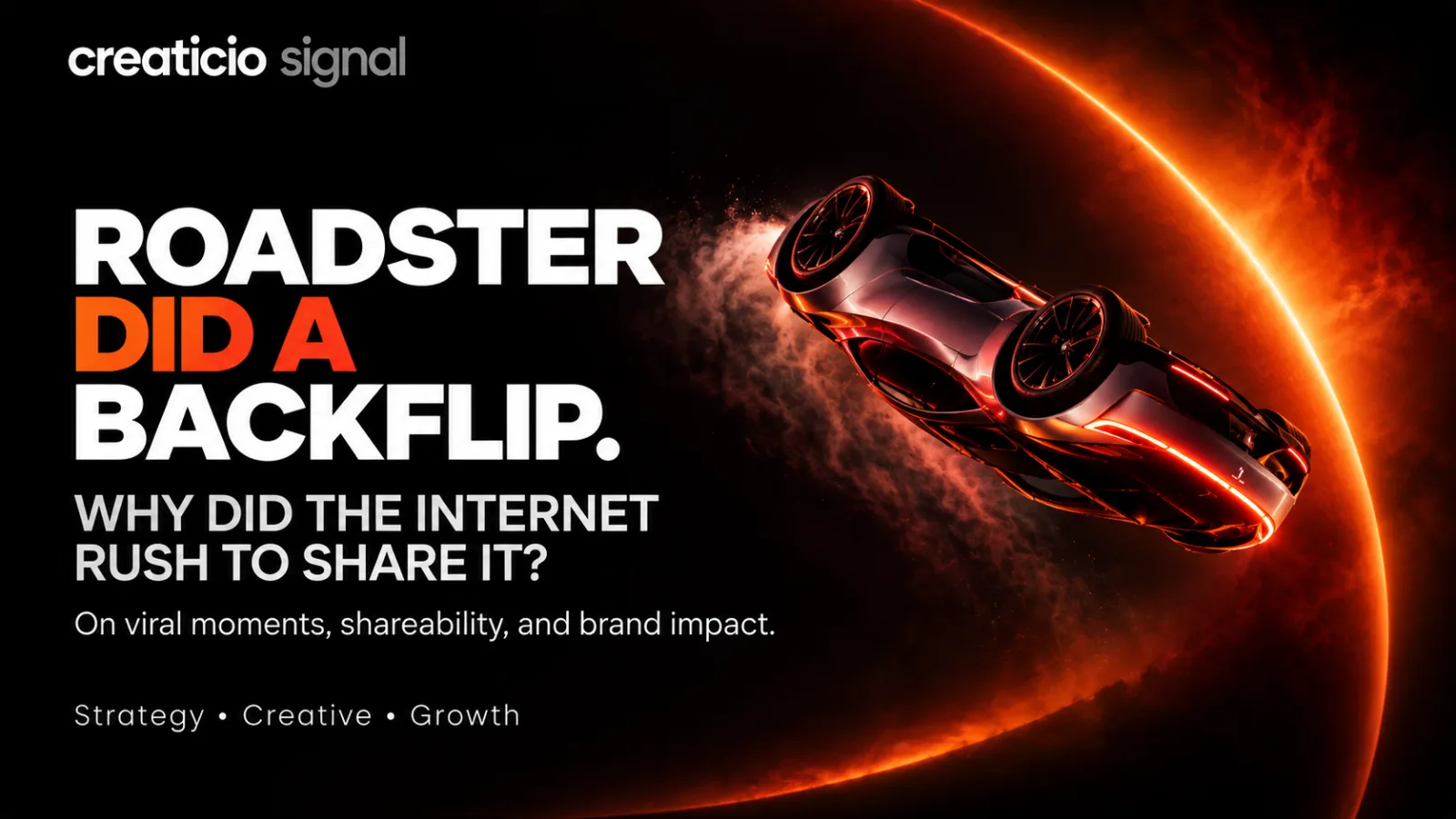
A CAR FLIPPED THROUGH THE AIR. THE INTERNET DID THE DISTRIBUTION.
On October 15, 2026, Tesla brought its next-generation Roadster back into the spotlight with a demonstration that looked very different from a conventional automotive launch.
The prototype moved through a specially designed ramp sequence, rotated in midair and landed back on its wheels.
Within seconds, the demonstration created something that could travel much further than a technical presentation: a remarkable visual moment.
Clips circulated across social media, attracting commentary, excitement and skepticism.
Some viewers were impressed by the engineering.
Others questioned the practicality and safety of the technology.
Some wondered whether the footage was real or AI-generated.
Different reactions. One shared subject.
People had something to talk about.
For Creaticio Signal #004, the most interesting question is not simply what the Roadster can do.
It is why certain product demonstrations become stories people voluntarily share, while others disappear after the presentation ends.
01 — TESLA TURNED A TECHNICAL CAPABILITY INTO A VISUAL EXPERIENCE
Traditional automotive launches often focus on specifications.
Acceleration. Power. Range. Design. Engineering.
These details matter, especially to potential buyers.
But communicating technical capability and creating a shareable moment are different challenges.
The Roadster demonstration brought these two objectives together.
Instead of relying exclusively on explanations about advanced engineering, it presented an unusual scene that viewers could immediately understand.
You do not need a background in automotive engineering to recognize how unexpected it is to see a car rotate in midair.
The concept is visually simple.
The execution is surprising.
That difference matters.
A technically impressive feature does not automatically become a compelling story.
Creative strategy helps translate real product capabilities into experiences people can understand, remember and discuss.
02 — THE ONE-SENTENCE TEST: CAN PEOPLE EXPLAIN WHY IT MATTERS?
Imagine trying to describe a long technical product presentation to a friend.
Now compare that with one sentence:
“Tesla's new Roadster did a backflip in midair.”
It is short.
It creates an immediate mental image.
And the listener already knows why the speaker found it unusual.
This simplicity can make content easier to share.
Social sharing is not merely about forwarding a link.
It is often a way of saying, “You need to see this.”
A strong creative concept gives people a simple reason to pass a story along.
The same principle can apply beyond automotive launches.
An industrial manufacturer's remarkable precision test, a software product simplifying a complicated task or an unexpected demonstration of durability can all become compelling visual stories.
The goal is not to explain every feature at once.
It is to reveal one powerful truth that deserves attention.
03 — SURPRISE CREATES ATTENTION. BRAND RELEVANCE CREATES MEANING.
Unexpected scenes can capture attention.
But not every surprising stunt creates meaningful brand value.
Why might an airborne Roadster demonstration make sense for Tesla?
Because Tesla has long associated its products with technological ambition and the idea of pushing engineering boundaries.
The demonstration can be understood within that broader brand narrative.
Viewers are not simply watching an unusual vehicle maneuver.
They are seeing a dramatization of the kind of technological ambition Tesla wants associated with its name.
However, there is an important distinction.
Attention does not automatically create trust.
An impressive demonstration does not resolve questions about safety, everyday usability, reliability or commercial availability.
A creative concept should therefore be evaluated through two separate questions:
Does it capture attention?
Does it reveal something meaningful and credible about the brand?
The second question is essential if the objective extends beyond a temporary spike in visibility.
04 — A SHAREABLE MOMENT DOESN'T REQUIRE EVERYONE TO AGREE
Not all viral content generates the same emotional response.
The Roadster demonstration provides an interesting example.
Some viewers may consider it an extraordinary engineering achievement.
Others may question whether the technology serves a useful purpose.
Some may focus on the safety implications.
Others may simply enjoy the spectacle.
These reactions can create different conversations around the same event.
For marketers, the distinction is useful.
Creating content people enjoy is not necessarily the same as creating content people want to discuss.
But disagreement should not become an objective in itself.
Misleading claims, manufactured controversy and unnecessary provocation may generate attention while weakening credibility.
Effective creative strategy considers not only whether people will talk, but also what that conversation may contribute to the brand.
05 — VIRALITY IS NOT THE SAME AS COMMERCIAL SUCCESS
The Roadster demonstration may be an effective communication moment.
That does not prove the vehicle will become a commercial success.
Nor does widespread media attention establish that the product is ready for everyday use.
Reporting on the demonstration has distinguished the prototype's capabilities from the practical and regulatory questions surrounding a future consumer version.
Production plans are also different from completed customer deliveries.
This distinction matters far beyond Tesla.
A campaign can attract enormous attention.
A video can be widely shared.
A product can dominate conversations across social platforms.
But business performance requires additional evaluation.
Did the campaign reach the right audience?
How did it influence perceptions of the brand?
Did it generate meaningful interest?
Did that interest develop into qualified demand?
What commercial outcomes followed over time?
The appropriate metrics depend on the campaign's objective.
A brand awareness campaign should not be evaluated in exactly the same way as a campaign designed to generate immediate sales inquiries.
Reach, engagement, trust, demand and revenue are related concepts.
They are not interchangeable.
Virality is a distribution outcome, not a complete growth strategy.
06 — WAS THE TESLA ROADSTER BACKFLIP REAL OR AI-GENERATED?
Today, extraordinary footage often produces an immediate question:
“Is this real?”
Tesla's October 15, 2026 Roadster demonstration took place at an event attended by witnesses and was covered through footage from multiple perspectives.
However, this does not mean that every Roadster clip circulating online shows authentic footage from that demonstration.
AI-generated remixes, edited videos and fictional recreations can circulate alongside original recordings.
A real event does not make every repost authentic.
For brands, this creates an increasingly important communication challenge.
As generating impressive imagery becomes easier, authenticity and verifiable sources become more valuable.
Surprise may attract attention.
Credibility helps determine what that attention means.
An ambitious creative concept should never depend on misleading the audience about what a product can actually do.
07 — FOUR CREATIVE LESSONS BRANDS CAN APPLY
Most companies do not need a vehicle performing a midair stunt.
For most businesses, such a demonstration would be entirely irrelevant.
The useful lesson is not to create a bigger spectacle.
It is to identify the most compelling truth about a product or service and find an effective way to communicate it.
Here are four questions worth asking.
- THE SINGLE-FRAME TEST
If you removed every written explanation, what could one image demonstrate about your product?
An industrial company might show a genuine quality-control process instead of making another generic statement about precision.
A software company might demonstrate how a complicated workflow becomes simpler.
The visual should reveal something meaningful about the actual product.
- THE ONE-SENTENCE TEST
How would a customer describe your content to someone else?
If the explanation requires a long introduction, the central idea may not be clear enough.
This does not mean the product itself must be simple.
It means the opening idea should be easy to understand.
- THE BRAND CONNECTION TEST
Why should this idea come from your brand?
If a competitor could replace your logo without changing the meaning, the concept may lack brand specificity.
Strong creative work connects attention to an authentic capability, a distinctive perspective or a recognizable brand characteristic.
- THE NEXT-STEP TEST
What should happen after someone watches the content?
Should they explore the product?
Understand a technical advantage?
Remember the brand?
Compare alternatives?
Contact the sales team?
Not every piece of content needs to generate an immediate conversion.
But every meaningful campaign should have a clear role within the broader communication strategy.
08 — THE CREATICIO PERSPECTIVE: CONNECTING CREATIVE IDEAS TO BUSINESS OBJECTIVES
The Tesla Roadster demonstration attracted attention because it presented something unexpected and visually remarkable.
But it also raises a more useful question for marketers:
How can a business turn a genuine strength into a story people want to share?
The answer is not always a bigger media budget.
It is not necessarily a more dramatic campaign.
Sometimes the opportunity lies in a product advantage that has never been communicated effectively.
Sometimes it is a customer problem that deserves a clearer explanation.
And sometimes it is the ability to simplify a complex capability into a moment people can understand in seconds.
The important part is ensuring that the creative concept remains connected to the product, the target audience and the brand's actual value.
There is a difference between content that people notice and content that helps people understand a brand.
FREQUENTLY ASKED QUESTIONS
Did the Tesla Roadster really perform a backflip?
At the October 15, 2026 demonstration, the Roadster prototype performed an aerial rotation using a specialized demonstration setup and returned to its wheels. This does not establish that the vehicle is capable of sustained everyday flight.
Is the Tesla Roadster backflip video AI-generated?
Footage of the official demonstration is based on a real event. However, AI-generated recreations and edited clips may circulate alongside authentic recordings. Individual videos should be checked against their original sources.
Why did the Tesla Roadster backflip go viral?
The demonstration combined an unusual engineering feat with a short, visually understandable and discussion-worthy moment. These characteristics likely contributed to its shareability. Establishing the relative impact of each factor would require audience and platform data.
What is viral marketing?
Viral marketing refers to approaches that encourage brand-related messages to spread through voluntary sharing between people. Widespread distribution does not automatically produce positive brand perception or commercial results.
How can brands create shareable content?
There is no guaranteed formula for creating viral content. Originality, a clear idea, credible evidence, relevance to the audience and compelling execution can help make content more shareable.
CONCLUSION — GREAT CREATIVE WORK DOESN'T HAVE TO MOVE AWAY FROM PRODUCT TRUTH
The Roadster's aerial maneuver was a remarkable demonstration.
The attention surrounding it illustrates a broader creative principle.
Technical capabilities can become stories people understand and share.
But a remarkable moment alone does not build a strong brand.
The meaning behind the moment, its connection to the company and the credibility of the claims all matter.
At Creaticio, we see creative strategy as more than the pursuit of attention.
It is about translating real business value into experiences that the right people can understand, remember and trust.
Because the most important result of a campaign is not always what people see.
Sometimes it is what they think about the brand afterward.
Creaticio — Strategy • Creative • Growth
Creaticio Signal #004
SOURCES AND IMAGE NOTE
This analysis draws on reporting published by Associated Press and The Verge on October 16, 2026, covering Tesla's October 15 Roadster demonstration.
The cover image is a conceptual illustration, not an official Tesla photograph or event still.